
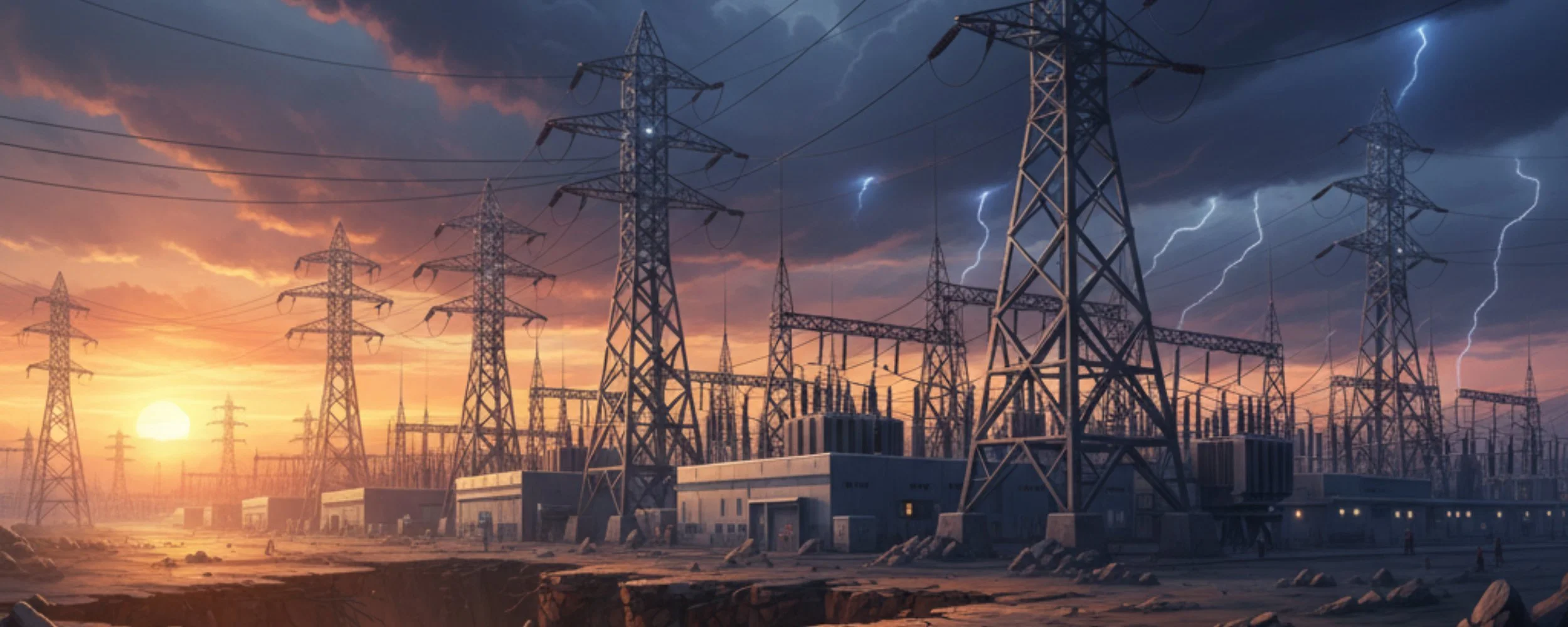
Everything that runs on electricity runs on trust. Hospitals, financial systems, water treatment, military installations, and now the data centers powering the AI economy all depend on its uninterrupted operation.
Over the next five years, the energy grid will experience the most concentrated expansion in its history. Yet the cryptographic trust layer protecting it is approaching the end of its effective lifespan.
The Pattern the Sector Keeps Repeating
The American electric grid began as isolated, city-scale systems in the 1880s. Over the following century, those islands were interconnected into regional networks, then national ones. Each expansion added reliability and efficiency, and each created new interdependencies that were not fully understood until something failed.
The digital revolution layered a second dimension of complexity on top of the physical one. SCADA systems enabled remote control of infrastructure that had previously required on-site operators. Enterprise IT networks connected to OT environments in the name of efficiency. Smart meters, IoT sensors, and distributed energy resources spread data generation to millions of endpoints. Throughout each of these transitions, the pattern was consistent: capability came first, and security reckoning followed.
AI, Data Centers, and a Grid Under New Pressure
U.S. data centers consumed 183 terawatt-hours of electricity in 2024, more than 4 percent of the nation's total power, according to IEA estimates. That demand is projected to grow by 133 percent by 2030, expanding four times faster than all other sectors combined. To keep pace, Amazon, Microsoft, Google, and Meta are expected to pour approximately $650 billion into capital expenditures in 2026 alone, a roughly 60 percent increase over 2025 levels, with the majority directed at data center infrastructure to support AI workloads.
The grid was not designed to absorb this level of demand this quickly. In July 2024, a voltage fluctuation in northern Virginia caused 60 data centers to simultaneously switch to on-site generators, creating a power imbalance that required rapid automated intervention to contain. Grid modernization, including advanced distribution management systems, real-time load monitoring, and AI-integrated demand response, is now a national priority.
Every device added to the modernized grid represents a new identity that must be authenticated. Every new data flow represents a channel that must be secured. Traditional perimeter-based security models were never designed for infrastructure at this level of distribution and scale.
Nuclear's Return, Oil & Gas Dependency, and a Fragile Supply Chain
The resurgence of nuclear power adds urgency to the architectural conversation. The Department of Energy awarded $800 million in federal cost-sharing to TVA and Holtec in late 2025 to support Small Modular Reactor (SMR) deployments in Tennessee and Michigan. The current administration has set a goal of quadrupling U.S. nuclear capacity to 400 gigawatts by 2050. Amazon, Google, and Microsoft are backing SMR ventures directly to meet the power demands of their AI infrastructure.
Every new SMR deployment involves a digital control architecture being built from the ground up. The cryptographic standards embedded in those control systems today will govern the security posture of those assets for the next half-century. As modern SMR designs integrate with grid management systems, the strict air-gap separation that nuclear facilities have historically maintained between OT and external networks is narrowing.
New deployments represent an opportunity to establish post-quantum resilience before legacy architecture decisions become technical debt. For the existing infrastructure that makes up the overwhelming majority of today’s energy grid, the window is not closed, but it is narrowing. Migration is both necessary and achievable through API-based PQC integration.
The broader energy mix driving all of this construction remains heavily dependent on oil and gas. Building SMR facilities, wind and solar farms, semiconductors, data centers, and transmission infrastructure requires industrial-scale manufacturing and logistics networks that depend on oil and gas production and delivery. The conflict with Iran has exposed the scale of that dependency.
Since the U.S. and Israeli strikes began on February 28, 2026, Iran's effective closure of the Strait of Hormuz, through which roughly 20 million barrels of oil and petroleum products transited daily before the conflict, has produced what the IEA described as the largest supply disruption in the history of the global oil market. Brent crude surged above $100 per barrel while Iranian drone strikes on QatarEnergy's Ras Laffan facilities further tightened global LNG supply.
The disruption has elevated fuel and feedstock costs for the same industrial sectors responsible for building out the grid, and it has made unmistakably clear that the physical and digital dimensions of energy security cannot be separated. The pipeline segments and refinery processes that keep this construction moving are monitored and governed by industrial control systems carrying decades of operational data, and that data is only as secure as the cryptographic mechanisms protecting it.
Two Worlds, One Broken Perimeter
Energy infrastructure operates across two environments that were never designed to share a security perimeter.
Information technology handles business operations: billing, trading, regulatory compliance, workforce management, and increasingly AI-driven forecasting and analytics. Operational technology controls the physical world. SCADA systems manage pipelines and substations. Distributed control systems run refinery processes. Industrial control systems and programmable logic controllers operate equipment across facilities that have run continuously for decades, with cybersecurity rarely a design consideration at the time of their construction.
This IT/OT convergence is accelerating faster than defenses are keeping pace. A 2024 Fortinet report found that 73 percent of organizations experienced an OT-impacting breach that year, up from 49 percent the year prior. NERC has warned that the number of vulnerable points on the U.S. electrical grid grows by approximately 60 per day.
The emergence of agentic AI systems making real-time operational decisions adds another layer of exposure: the identity and authentication infrastructure governing those AI agents is now, in effect, energy infrastructure too. Credential-based access controls, designed for human operators in centralized environments, were never built to govern millions of devices and autonomous agents across a decentralized grid.
What Quantum Actually Breaks
The current trust architecture of energy infrastructure depends on cryptography at every layer. Encrypted channels protect SCADA communications. Digital certificates authenticate operators and devices. Cryptographic signatures verify firmware updates. VPNs secure remote access for field technicians. These mechanisms all rest on mathematical problems that quantum computers running Shor's algorithm will be capable of solving.
In 2015, a cyberattack on Ukraine's power grid left 230,000 people without electricity in the middle of winter. It was the first confirmed instance of a cyberattack causing a large-scale power outage, and it was executed entirely with classical tools. It was not an isolated warning. Between 2017 and 2019, Russian state-sponsored actors gained access to the control rooms of U.S. electric utilities, a campaign confirmed by DHS and FBI, where they had the capability to flip switches and cause outages but stopped short of doing so. Quantum computing removes the barriers that currently limit that kind of attack to well-resourced nation-state actors.
The harvest-now-decrypt-later threat compounds this further. Operational data recorded from a pipeline control system today could be decrypted within ten years, giving adversaries a detailed map of control logic and potential attack windows. Ransomware attacks targeting energy and utilities increased 80 percent in 2024, per TrustWave's January 2025 report. The 2024 Halliburton breach, executed through standard credential theft, forced systems offline, resulted in confirmed data exfiltration, and cost $35 million in direct losses. The 2021 Colonial Pipeline shutdown traced back to a single compromised VPN password. These exploits were enabled by architectural shortcomings. Under traditional security models, quantum computing makes those vulnerabilities structurally unresolvable.
Why the Architectural Assumptions Need to Change
The energy sector's planned response follows a familiar playbook: inventory cryptographic assets, prioritize migration, and extend existing IAM frameworks to cover new devices. For organizations managing a bounded set of systems, that is reasonable, but the grid being built right now is not a bounded system.
Traditional identity and access management (IAM) was designed for human operators logging into centralized systems behind a defined perimeter. That perimeter no longer exists. A grid with millions of IoT sensors, AI agents making autonomous operational decisions, and distributed energy resources connecting dynamically across thousands of miles has no clear boundary to defend. Credential-based access breaks down when the number of identities reaches that scale. Stolen credentials become master keys.
The Compliance Clock Is Running
NERC CIP standards govern cybersecurity for bulk electric system operators, and OMB post-quantum cryptography migration mandates are actively shaping procurement decisions across the public sector. CISA has expanded its OT cybersecurity guidance for critical infrastructure operators, and cross-agency coordination on implementation timelines is accelerating. Recent analysis found that only 6 percent of internet-accessible SSH servers have adopted quantum-resistant encryption, a documented gap with direct implications for energy infrastructure that is increasingly internet-accessible.
Organizations making the right architectural choices now will occupy a substantially different compliance posture than those treating post-quantum migration as a layer to add later.
An Architectural Answer to a Structural Problem
The modernized grid requires an infrastructure layer where trust is cryptographic, IAM is decentralized, and the security foundation holds for the lifespan of the assets it protects.
That layer connects to existing OT environments, IT networks, IoT sensors, and AI-driven management systems through standard APIs. Data is normalized across previously incompatible systems and validated on a quantum-resistant ledger, producing a tamper-proof audit record and a single source of truth across infrastructure that has historically had neither. Legacy systems remain in place. The integration happens at the infrastructure layer on which they operate.
Identity across this environment runs on the same principle. Every operator, authorized device, and automated agent holds a cryptographic identity tied to a private key that never leaves their control. Access to SCADA systems, control panels, and remote assets requires a valid quantum-resistant digital signature for every interaction. The credential-based attack surface that enabled Colonial Pipeline and Halliburton is eliminated by design.
This is the architecture the Intrana Network provides, built on NIST-standardized post-quantum cryptography from genesis. The same quantum-resistant signatures securing every transaction also govern every identity, every access event, and every data record across connected infrastructure. As the grid absorbs AI workloads, SMR output, and distributed generation at millions of endpoints, the trust layer beneath it scales without the vulnerabilities that centralized identity models cannot resolve at that volume.
The Foundation Beneath Everything Else
The grid runs on digital trust. Commands are followed because digital signatures verify. Updates are applied because digital certificates authenticate. Access is granted because digital credentials pass. Quantum computing does not attack grid infrastructure directly. It attacks the trust layer that makes the infrastructure controllable. The surface of that trust layer is being extended right now to cover an expanding universe of AI systems, IoT devices, SMR control architectures, and grid modernization endpoints.
The energy grid cybersecurity conversations happening in Washington, DC are timely. The question is whether the strategies being proposed are built on a foundation that will hold strong for the next century, or whether the energy sector is about to repeat the same pattern it has followed every time before: plastering security "solutions" on top of increasingly complex architecture.
Building this massive grid expansion on quantum-vulnerable cryptography, credential-based identities, or centralized networks will turn the $2 trillion modernization effort into a $2 trillion liability.
Whether the work ahead involves building post-quantum cryptography into new infrastructure or establishing the migration path for systems already in the field, the architectural decision is the same.
